I just came across Sistren Theater Collective while researching for my current project. I am reading the book "Bananas, Beaches, and Bases, Making Feminist Sense of International Politics." There is a fascinating chapter on the Banana industry. The author focuses on how these plantations perpetuate system of patriarchy and race discrimination.
Here is a little bit on Sistren:
Sistren Theatre Collective (Sistren) began in 1977 as an Independent Cultural organization of working class women who employed popular theatre techniques in their exploration and analysis of the social, political and legal condition and status of Jamaican women. Focussing particularly on poor black women, Sistren uses personal testimonies as a critique of a system, which discriminated against women on the basis of gender, class and colour.
July 17, 2013

April 25, 2013
Curated Stacks
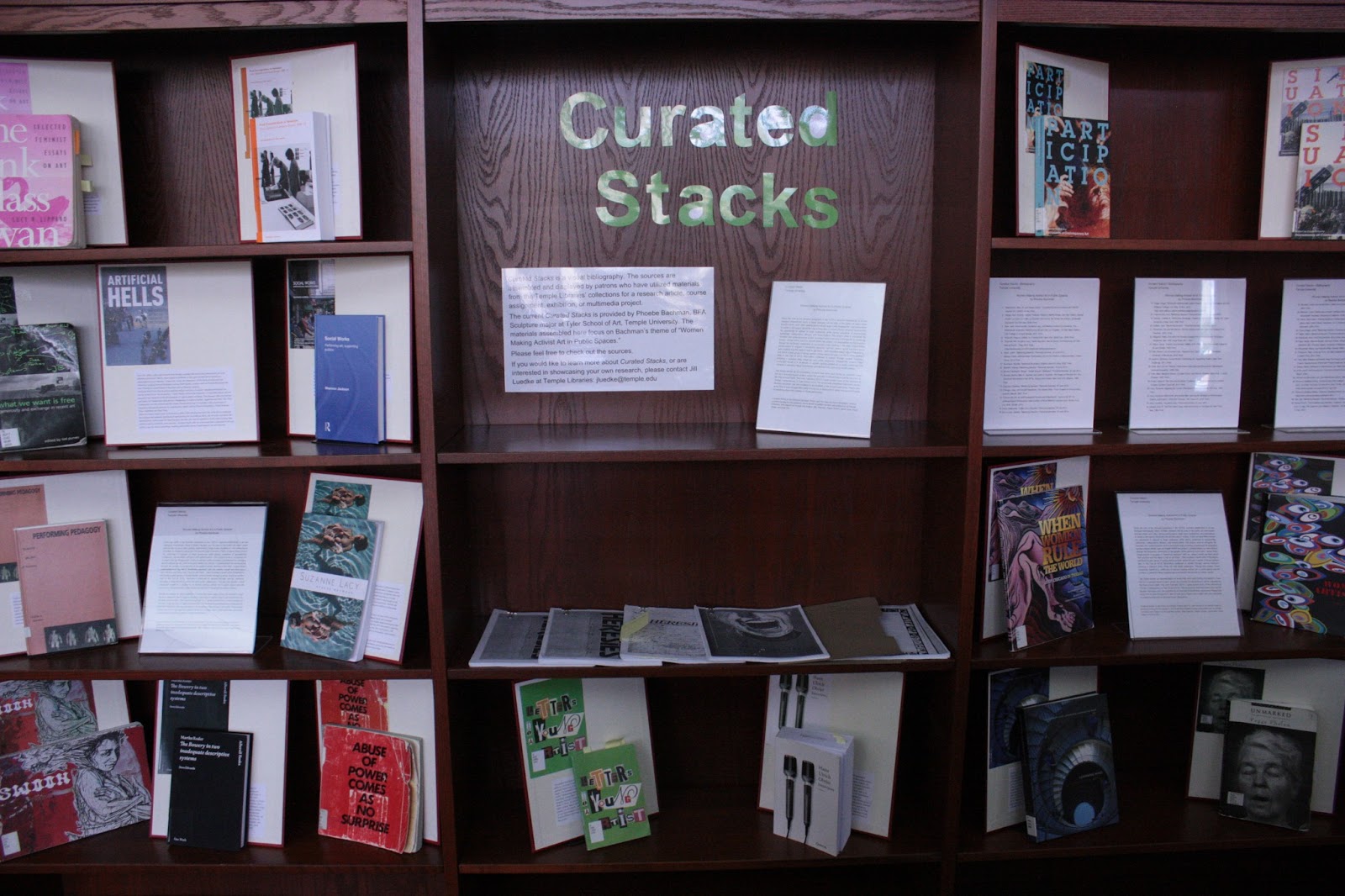
For the past few months, the Temple Art Librarian, Jill Ludke and I have been working on a project called "Curated Stacks." The project aims to make research more accessible by showing a visual bibliography. Here is a link to Jill's description of the project: Curated Stacks

While I have not posted in a few months, WMAAPS has continued to live through the connections I've made. This semester, I have been doing a lot of research on food production/ feminism/ globalization/ localism. It feels great to have a direction that I am taking my work. This summer, my sister and I will be collaborating on a project in Philadelphia that has to do with local food initiatives.
February 2, 2013
Transcripts
PRESENTATION!!
http://phoebe-bachman-temple-contemporary-eorg.eventbrite.com/
Coming up! Please come and bring your friends.
I've been reading through my transcripts and getting more and more overwhelmed by the incredible impact these women have had on me. I am forever grateful to have had this experience.
Some bits I'd like to share:
Janet Owen Driggs: And as Tania Bruguera said at the conference in Portland recently--Open Engagement, the social practice conference--she said that conceptual art is not political art. She didn't say this, I'm gonna say this. Conceptual art is fun and wonderful mind games, but it doesn't act on the ground. It might sometimes act peripherally in small and subtle ways on people's thinking, but as far as I'm concerned that's not enough. Art needs to be much more direct. So I kind of, you know, I'm always willing to leaner (laughing) and I learned, and I was intrigued, and the chess game of conceptual art is a wonderful thing, just as chess games are. But that's not why I'm interested in doing art, and it's not how I'm interested in acting in the world. By this time, I understood how far my work as an artist had come from my being as a political human.
http://phoebe-bachman-temple-contemporary-eorg.eventbrite.com/
Coming up! Please come and bring your friends.
I've been reading through my transcripts and getting more and more overwhelmed by the incredible impact these women have had on me. I am forever grateful to have had this experience.
Some bits I'd like to share:
Janet Owen Driggs: And as Tania Bruguera said at the conference in Portland recently--Open Engagement, the social practice conference--she said that conceptual art is not political art. She didn't say this, I'm gonna say this. Conceptual art is fun and wonderful mind games, but it doesn't act on the ground. It might sometimes act peripherally in small and subtle ways on people's thinking, but as far as I'm concerned that's not enough. Art needs to be much more direct. So I kind of, you know, I'm always willing to leaner (laughing) and I learned, and I was intrigued, and the chess game of conceptual art is a wonderful thing, just as chess games are. But that's not why I'm interested in doing art, and it's not how I'm interested in acting in the world. By this time, I understood how far my work as an artist had come from my being as a political human.
Callie Curry (Swoon): But there like tends to be, in a lot of different systems, this like magic level of energy input and variables that allows you to, to have patterns emerge, and to have things form, and things stick together. So in my mind I was like, this feels very connected to like growth and healing, and to the fact that like things don't all just die and fall apart--they are born and they do heal, and things do regenerate themselves. And um, I really don't remember what I was talking about…Oh I was talking about sort of pessimism versus hopefulness. So feeling that if I could somehow align myself with that knowledge and be like things to come back together, things do form, things do regenerate, that like there is this lie force in the world that's about sticking things together and making meaning out of senselessness. And being like, ok I'm on that team (laughing), you know? There's only a few people on that team, but if you look at the whole world, there's some pretty remarkable people on that team.
#00:43:24-6# Judy Baca: Yeah. I mean, I didn't, well it's a little bit more complicated, but I mean all the politics and then what I had learned about how to advocate for that position…it was, I was just an administrator. So that's how I ended up doing it. I mean, I ended up, um, meeting the boys, putting together the first teams, realizing that they needed work and that they were really open to the idea of, you know, advocating for peace between them. They were willing to put down their knives for brushes, as the LA Times said. And I became quite famous very fast all along the country because, um, there was this woman working in the deep gang warfare areas, and there was like the knives for brushes kind of headline…and they'd never seen anything like it.
Peggy Diggs: They had all these very colorful terms for what girls were called. but two for what
boys were called. So I had, through discussions with them, brought a bunch of white dress shirts and then had them silk-screened with these names on the back. And they were not ironed. I wanted to get them ironed, folded and put into plastic bags. So I took them to a local laundry
here, and I gave the laundry like 700 shirts. The women at the front desk said ohh I don't know
about this. And they brought the owner over, who was a very old kermugin guy and he looked at
it and said this is an outrage, that's just terrible, I don't think I want your business.
Phoebe Bachman: Oh wow.
Peggy Diggs: So I looked at him and said, 'then you know exactly how these girls feel who are
called these names and that’s the reason these shirts are being produced, to call attention to these horrible things that the girls were being called. That's all it took. He started smiling. and said oh then we welcome your business.
Phoebe Bachman: That's so interesting.
Peggy Diggs: It's these surprises that make this work so exciting. how you can unexpectedly
reach even one person in a very unexpected way. I love it.
boys were called. So I had, through discussions with them, brought a bunch of white dress shirts and then had them silk-screened with these names on the back. And they were not ironed. I wanted to get them ironed, folded and put into plastic bags. So I took them to a local laundry
here, and I gave the laundry like 700 shirts. The women at the front desk said ohh I don't know
about this. And they brought the owner over, who was a very old kermugin guy and he looked at
it and said this is an outrage, that's just terrible, I don't think I want your business.
Phoebe Bachman: Oh wow.
Peggy Diggs: So I looked at him and said, 'then you know exactly how these girls feel who are
called these names and that’s the reason these shirts are being produced, to call attention to these horrible things that the girls were being called. That's all it took. He started smiling. and said oh then we welcome your business.
Phoebe Bachman: That's so interesting.
Peggy Diggs: It's these surprises that make this work so exciting. how you can unexpectedly
reach even one person in a very unexpected way. I love it.
January 29, 2013
Mary Beth Edelson
Works of Activism and Groups
Just ran across her work... check out We have what it takes to hang in Pace Gallery, 1994

I believe this first appeared in Chrysalis? Correct me if I am wrong.
Just ran across her work... check out We have what it takes to hang in Pace Gallery, 1994
I believe this first appeared in Chrysalis? Correct me if I am wrong.
January 28, 2013
Laundry Works
Mother Art Laundry Works
Laundry Mats have long been used as a place for public interventions. Mother Art, a collective from the 70's, 80's, brought their perspectives as mothers and artists to Laundry Mats in LA.
“Articulate, timely and provocative, Mother Art considered the effects
Laundry Mats have long been used as a place for public interventions. Mother Art, a collective from the 70's, 80's, brought their perspectives as mothers and artists to Laundry Mats in LA.
“Articulate, timely and provocative, Mother Art considered the effects
of its work, especially Laundry Works, on a deep social and psychic level: ‘It crossed class lines; there was something absolutely wonderfully material about dealing with the sheer transformation of dirty clothes-wet, dry and the cycle, the literal revolution -and the metaphors are ripe for connections with social revolution, perhaps even something unimagined, perhaps utopian.’"
 ‘It crossed class lines; there was something absolutely wonderfully material about dealing with the sheer transformation of dirty clothes-wet, dry and the cycle, the literal revolution -and the metaphors are ripe for connections with social revolution, perhaps even something unimagined, perhaps utopian.’"
I think about my own work with laundromats... the menstruation series where I went and interviewed various women at laundromats around the city.
Description of that project:
"For my last cycle (November, 2012) I chose to use hand made sanitary napkins that I had sewn together. To clean the pads, I took them to several laundromats in the city. During the time span of washing and drying the pads, I would ask women in the laundromats to speak to me about menstruation. I let them know that I was a young woman interested in how other women dealt with their periods and why they thought it was taboo to speak about in public. I asked them if I could record the conversations with audio and each one consented. The conversations varied in length but inevitably ended up touching on multiple topics outside of menstruation. The text that follows comes from partial transcripts from the conversations, focusing particularly on menstruation." -Phoebe Bachman (myself)
There of course, is also the Laundromat Project.
"The Laundromat Project is a community-based non-profit arts organization committed to the well-being of people of color living on low incomes. Understanding that creativity is a central component of healthy human beings, vibrant neighborhoods, and thriving economies, we bring art programs to where our neighbors already are: the local laundromat. In this way, we aim to raise the quality of life in New York City for people whose incomes do not guarantee broad access to mainstream arts and cultural facilities."
Laundromats are interesting because of their function as community centers. Particularly in places like New York and San Francisco, where there are laundromats on every other corner.
Quote
“Strong feminist art might or might not be obviousy political. By virtue of its expression of a repressed cultural experience, it will always in fact be political, as long as women’s experience is not widely acknowledged in our society. The purpose of feminist art (and contrary to the myth of functionless art, it does have a purpose) is to provide information about women’s way of seeing, to invite an exchange with its audience on the issues within the work, and put forth a visuion of a feminist culture. Concerned with communication about all else, feminist art cannot rest on prior assumtions or conventions about the nature of art. Its shape will be as radical as its contents." - Suzanne Lacy, Frontires: A Journal of Woman Studies
January 23, 2013

January 22, 2013
Spring Semester
Alas, it is already the spring semester and I am already getting back to hard work. As I prepare for my presentation (february 4th at Temple Contemporary,) I am going over old notes that I had taken during intensive research. This project has become so much of a mirror of itself. I am creating a social practice project while researching social practice. Oy.
One significant aspect of this project was to find a way to balance art and activism. As if there was a magic recipe... In many ways I have lost what it means for me to be an activist. Today, in my "Social Practice Class," we watched Nato Thompson's presentation on Living as Form. At one point he said that "to make meaning is a form of resistance." Resistance is communicating in a way that is against the norm or current form of power. In small ways artists create forms of resistance every day. They create new ways and possibilities of seeing the world. And in some cases, maybe this is all we can hope for, to create an opening for others to see the world in a new critical way.
Many of these women open up these doors in different ways. Whether it is Swoon pasting on a street corner to draw attention to an abandoned wall, Suzanne Lacy using social media and public performances to raise awareness about Rape, or Peggy Diggs leaving don't drink and drive coasters in bars. These artists create moments of clarity, understanding, that are accessible, and artistic. Subjective Rupture.
There are small ways of being an activist. I am an activist in my daily interventions, creating moments of resistance. In many ways though, these projects seem like smaller gestures for larger activist movements. What are those larger activist projects? When do I find something to specialize in? Take advantage of my passion for larger social movements.... It is about time to have a specialized research driven project that reflects that.
One significant aspect of this project was to find a way to balance art and activism. As if there was a magic recipe... In many ways I have lost what it means for me to be an activist. Today, in my "Social Practice Class," we watched Nato Thompson's presentation on Living as Form. At one point he said that "to make meaning is a form of resistance." Resistance is communicating in a way that is against the norm or current form of power. In small ways artists create forms of resistance every day. They create new ways and possibilities of seeing the world. And in some cases, maybe this is all we can hope for, to create an opening for others to see the world in a new critical way.
Many of these women open up these doors in different ways. Whether it is Swoon pasting on a street corner to draw attention to an abandoned wall, Suzanne Lacy using social media and public performances to raise awareness about Rape, or Peggy Diggs leaving don't drink and drive coasters in bars. These artists create moments of clarity, understanding, that are accessible, and artistic. Subjective Rupture.
There are small ways of being an activist. I am an activist in my daily interventions, creating moments of resistance. In many ways though, these projects seem like smaller gestures for larger activist movements. What are those larger activist projects? When do I find something to specialize in? Take advantage of my passion for larger social movements.... It is about time to have a specialized research driven project that reflects that.
January 9, 2013
New Year, New Post
Happy New Year!
It’s about time that I updated this blog and said something new and somewhat worth while.
For the past few weeks, I’ve been in California visiting family and friends and doing a small bit of work. I came to the city prepared to buckle down on my presentation (which I am giving in February) and found that I was not meant to do that. Instead I listened to a lot of great music, went on hikes, found beautiful driftwood by the beach and met incredible people. Not too bad for a vacation, not too bad at all.
Now, as I am sitting in the San Francisco Public Library in the Mission District, I am trying to ease myself back into productivity mode. Though, the past few weeks haven’t been completely unproductive. Last week a friend and I visited this over stacked used bookstore in downtown Santa Rosa. Immediately I found myself turning pages in the art section, climbing up tall step-stools and looking to the backs of book pies. Amongst the coffee table Matisse books and the how-to-collage manuals I found a tiny paper back titled “Radical Perspectives in the Arts.” After reading the introduction I knew I had to buy it. The edition is a collection of essays edited by, Lee Baxandall, about the relation of the arts to capitalism, communism, class-values, patronage, property, realism, and the freedom of expression.
Baxandall begins by stating the definition of Radical, as defined by Webster’s 3rd Unabridged International Dictionary.
“Radical: 1.of or relation to the root: proceedying directly from the root... 2. Of or relation to the root or origin... 3. Marked by a considerable departure from the usual or traditional.
Radical does not mean extremist.”
He goes on to relate radical to fundamental and insist that we, as readers, must obtain a firm grip on the word as to re-define the meaning of words in our language, and deviate from the one-dimensional definitions we suppose are true.
By re-defining words such as radical we open up possibilities for new understandings and new relationships.
Another quote from the forward:
"The flaw at the very root of the arts in a class-hierarchical society of whatever era may be most penetratingly described in terms of Marx's concept of alienation. Class attitudes and class oppression are the interpersonal manifestation of it; but alienation permeates the individual to the marrow of his or her potential to realize personal abilities and to live happily. It is a psychological phenomenon with socio-economic foundations which affect - to stick only to the arts and to touch only highlights - the capacity to utilize one's aesthetic potential, the art-making or the craft process, and the market or patronage for art." (Baxandall 12)
Though what really struck me was Meredith Tax's essay "Introductory: Culture is not Neutral, Whom Does it Serve?" In this she explores the thesis that culture is not neutral politically. (of course right?) But she does this beautiful explanation interweaving poems by Brecht and Yeats and tying in Marx as well. One point she makes early on is about the absurdity of the art market and its relation to value. "It is only with the dominance of the capitalist system that the artist has been put in the position of production for a Market, for strangers far away, whose life styles and beliefs and needs are completely unknown to him, and who will either buy his works or ignore them for reasons that are equally inscrutable and out of his control." (22)
She goes on to explain that Marxist call this attitude towards production "commodity fetishism." A term I am sure many of you have heard. "Objects are regarded as though they had originated by magic and appeared in the shops, not as if they were made by people for other people to use." (23)
In her next section, she writes about 'High Brow' culture and 'low brow,'
mass culture. High Brow of course concerning students, intellectuals, upper middle class folks, you know the ones that are more likely to visit museums and fund the art market. Mass culture, in her words, "proletarianized art," comes from the "manipulation of a national fantasy life." (25)
She ends by writing this paragraph
"As politics must teach people the ways and give them the means to take control over their own lives, art must teach people, in the most vivid and imaginative ways possible, how to take control over their own experience and observations, how to link these things with theory, and how to connect both with the experience of others."
Now the academic in me is sleepy as the sun sets outside the large library windows. I want to say that, despite my efforts to push myself away from the traditional academic sphere, I can't help but embrace these essays. I am sorry for the lack of analysis, but I think it is more interesting for you to interpret what you will based off of the pieces I have selected.
In other news,
I met Amy Franceschini today for a mentoring session and a bit of tea in the mission. We spoke about a wide range of things, from working in institutions, to urban agriculture, to being a role model for future generations.
I've also been thinking about the idea of a third place. It is a place that is not the home nor work. A place for people to come and socialize on an equal playing field that does not cost money or is very cheap. Urbanism, social interactions, communication, spaces--- all good things.
Off to catch the Bart.
December 10, 2012
End of the Semester
As the semester winds down and I start to regain some sanity, I've been thinking over the amount of information I've gathered in such a short time period. I'm exhausted and in need of a break. Over the winter holiday, I'll be putting together a presentation set to happen in February at Temple Contemporary (Tyler's art gallery.) The presentation will be a way for me to disseminate some of my findings and to localize this effort within Philadelphia.
In about two weeks, I'll be going back to California to stay with a friend of mine and do a bit of relaxing. While over there I plan to speak with the artist Amy Franceschini from future farmers. My friend and I also plan to take a road trip up to Portland, where hopefully, I'll get to visit Portland State University and hear about their social practice program.
A professor of mine recommended that I move away from these artists for a while. That I try and focus on my own work, and my process of making. She gave me a few fiction books to read over break. I've already been eager to jump into them, fantasizing about sitting in a leather chair, book on my lap, hot tea in my hand.
This semester has been rough in dealing with whether to be more of an academic or more of an artist. Different classes pulled me different ways, and often I felt torn at the center. My mind trying to wrap around various disciplines and discourses. If I look back on some of my past projects from the semester, I am relatively happy with where I've gotten. Perhaps, it is not my best work... and maybe I shouldn't have taken six classes... but I've learned a lot.
In November, I spoke with the artist Peggy Diggs and we had a really wonderful mentoring session/ conversation. Since I am in a state of catching up-- on sleep, on finals, on blog posts, the re-cap of that session will be left to a later date.
Cool site:
In about two weeks, I'll be going back to California to stay with a friend of mine and do a bit of relaxing. While over there I plan to speak with the artist Amy Franceschini from future farmers. My friend and I also plan to take a road trip up to Portland, where hopefully, I'll get to visit Portland State University and hear about their social practice program.
A professor of mine recommended that I move away from these artists for a while. That I try and focus on my own work, and my process of making. She gave me a few fiction books to read over break. I've already been eager to jump into them, fantasizing about sitting in a leather chair, book on my lap, hot tea in my hand.
This semester has been rough in dealing with whether to be more of an academic or more of an artist. Different classes pulled me different ways, and often I felt torn at the center. My mind trying to wrap around various disciplines and discourses. If I look back on some of my past projects from the semester, I am relatively happy with where I've gotten. Perhaps, it is not my best work... and maybe I shouldn't have taken six classes... but I've learned a lot.
In November, I spoke with the artist Peggy Diggs and we had a really wonderful mentoring session/ conversation. Since I am in a state of catching up-- on sleep, on finals, on blog posts, the re-cap of that session will be left to a later date.
Cool site:
November 19, 2012
"When we see beauty we see hope"- Lily Yeh
 |
| Genocide Memorial Proposal- Lily Yeh |
I met with Lily in a Cosi near Rittenhouse square on a cold Friday morning. We sat at a table near the floor to ceiling windows and began to speak about my expectations. Lily said that she might not be able to answer some of the questions and I explained that it was ok, they were just there for guidance if she did not naturally bring up things I wanted to touch on.
We began, as I always do with talking about where she grew up and her transition into public artwork. The whole time we were speaking, I kept seeing these beautiful yellow flowers in my head, made out of mosaics. The conversation was magical and inspiring. Lily's passion is infectious and it is easy to see why her art appears the way it does. For her, it all comes down to a level of authenticity. She needs to be true to herself and out of that comes the rest. She describes her work as coming out organically. Building a place for healing in Rwanda was what needed to be done. We spoke about the artist as a person who can open up possibilities. Through beauty we can create space, healing, and dialogue. She told me it comes from organizing yourself, and improving yourself-- taking the freedom to explore who you are and what that means through these different contexts.
For her, it is about the desire to solve social problems. The art comes out of listening. When I asked her about the significance of being a female and creating this work, she spoke to me about feminine energy. That the world needs women artists, that we bring the emotional, physical, mental care as well as the intuitive nature to the space.
After speaking with Lily, I was overcome with this sense of joy and possibility. Through talking with her, I could sense the effects that artwork can have transforming a blighted area, or a group that is dealing with immense pain. Her methods of taking what is broken and putting it back together through mosaics, is more than poetic, it is moving. She is a wonderful role model to have and I feel honored to have been able to absorb her kindness and wisdom.
Here is the group that Lily founded called Barefoot Artists. I came across Lily's work through learning about the Village of Arts and Humanities in North Philadelphia. Check out the websites, and also watch the trailers for Lily's new documentary.
November 12, 2012
November already? A mix of jumbled notes- Mierle Ukeles Visit
Hosting my first dinner party tonight since the first was postponed due to Sandy.
If anyone is interested in helping out with disaster relief, Occupy Sandy is doing a great job.
Reading list that Bad at Sports posted for new years in January 2012: Reading List
Also if you get the podcast from itunes then you can download a very interesting interview with Shannon Jackson who wrote Social Works and will be at the performance (conference?) at Moma this weekend. The episode is 376, and should be released next week on their website.
conference: How are we performing today?
I've been thinking recently about how much socially engaged art enters into my practice. Would I call myself a socially engaged artist? Surely that is what I am most interested in speaking about, but why? What does it really mean to work in the social sphere and can socially engaged art be effective. I just heard Shannon say in the podcast that it may not be the aesthetic vs. use but an exploration of truth or meaning.
This past week has been overwhelming, a bit stressful, but overall incredible. On Thursday, I went to pick up Mierle Laderman Ukeles at 30th street station, for a lecture at temple. Immediately, she was asking questions about Tyler and the community arts program. As I tried to navigate Philadelphia traffic, I answered her as best I could. She was so inquisitive about how students were engaging with art at Tyler and what I was doing. I told her about my project and she was curious about the decision to describe it as mentoring sessions rather than interviews. I explained how when I began learning about these practices, my own practice had yet to be formed (not to say it has been formed now), so these conversations were a way for me to contextualize my practice and to learn tactics and methods for dealing with a very difficult art form.
She seemed interested in the prospect of doing one, but when we spoke more in depth about the projects I had been doing this semester she seemed to think that it might be time I stop looking at my mentors and begin to delve deep into my own art. This semester has been a very tough few months. I've been trying to balance academics, art, work, and research and have found that I don't nearly have enough time to do everything. I have managed to put together a series of works that I am interested in pursuing but I am constantly questioning my work. Part of this might be that I lack the support structure of other peers pursuing this type of art. I am researching collaborative environments and yet I come up alone. I know there are students at my university who are interested in community arts but it has been hard trying to bring people together. Hopefully, the dinner parties will provide a community of artists that can come together and support each other.
Back to Mierle's visit--- She gave an incredible lecture at Temple Contemporary but unfortunately some of her projects were cut short by the time limit. The way she spoke was like one long poem, folding in quotes and reactions, descriptions and details. There was a great turn out for the event, people were leaning against the walls and sitting on the floor. After the lecture, I got to go to dinner with Mierle, the co-directors of the Community Arts program, the head of Temple Contemporary, and a few other wonderful people. Each brought an interesting conversation to the table about Mierle's practice but also about the state of socially engaged art at Temple and the state of Temple as a "public" institution. As a young artist, and well frankly as a person, it was such an honor to be able to sit in on that conversation and participate.
In the morning on Friday, I picked Mierle up at her hotel and we drove through North Philadelphia on the way to campus. We stopped by where many of the students live, just west of Broad, so I could show her the area and a glimpse of the dynamic between students and residents. This also gave her some context for the breakfast conversation that Rob was holding at the Gallery. The breakfast was a chance for people all over campus to come together to discuss their role on campus as well as a chance for them to meet Mierle and ask her any questions that they had. It was a diverse group of people. From the head of facilities, to professors from the Art Ed department. There was a guy who headed a residency program that brings together artists and recycled material (RAIR,) a woman who was the head of the (no longer?) Woman's Studies Program, a graduate student who has been working with socially engaged art and maintenance, a documentary film maker, and the head of Temple Grounds. I just wish we had more time to speak. It was an incredible experience to have all of these people in one place. I even got to speak about my own practice and the type of work I have been exploring. One question that someone asked Mierle which I found to be kind of amazing, was, who were her supporters? As she went day in and day out to work with these Sanitation workers, who told her to keep going? She said that Hannah Wilke and Ana Mendieta told her to keep going.
After breakfast, I drove Mierle over to the train station for her departure to New York. We said we would stay in touch. At a time when I feel often dismayed and disappointed by critiques and conversations in Tyler, it is nice to know that someone is pushing me forward. These women have opened a mental space for me to push boundaries, question, but most importantly stay genuine to what I believe.
October 31, 2012
Spectre of Evaluation
 |
| Thomas Hirschorn, Spectre of Evaluation, 2010, ink on paper |
October 30, 2012
Sandy Troubles
As all of us know, Sandy has brought devestation to many areas throughout the north east. In preparation for the hurricane, many of my fellow dinner party go-ers had to cancel. I am now in the midst of rescheduling and figuring out logistics.
As of now the dinner parties are scheduled for:
4th of November (potentially-- see how many people can come to this one)
12th of November
30th of November
If you're interested email me at activistart@phoebebachman.com
Or just leave a comment below!
Hope you all were safe in the storm and don't have too much damage.
Here are some great quotes to leave you with:
"This is something essential to art: reception is never its goal. What counts for me is that my work provides material to reflect upon. Reflection is an activity." Thomas Hirschorn
“I have consistently been interested in addressing the art world. If wasn’t I would have obviously gone into politics or something else. I mean after all, lets talk real change." Suzanne Lacy (Bad at Sports Podcast)
As of now the dinner parties are scheduled for:
4th of November (potentially-- see how many people can come to this one)
12th of November
30th of November
If you're interested email me at activistart@phoebebachman.com
Or just leave a comment below!
Hope you all were safe in the storm and don't have too much damage.
Here are some great quotes to leave you with:
"This is something essential to art: reception is never its goal. What counts for me is that my work provides material to reflect upon. Reflection is an activity." Thomas Hirschorn
“I have consistently been interested in addressing the art world. If wasn’t I would have obviously gone into politics or something else. I mean after all, lets talk real change." Suzanne Lacy (Bad at Sports Podcast)
October 25, 2012
Andrea Fraser Podcast
Listen to this if you get the chance:
Andrea Fraser- Bad at Sports Podcast
She brings up some very salient points that resonated specifically with my own work. It's a long podcast with a lot of different ideas brought up so it becomes hard to narrow it down. I will say, that at a point she is speaking about performing her relationships to a group, instead of performing that specific group. In this way she is always present as herself while embodying other characters persona's. I find this extremely interesting because she is allowing herself to explore that in-between space of creating a dialogue within a larger conversation.
I think that these were some of the issues I have been trying to work through in my own performances. For me, it becomes less about the specificity of a character but about the nature of how I would interact with that character and what that interaction would look like. Who is that person to me? I'm speaking in reference to a piece I just did where I attempted to take on the persona of a 1970's feminist performance artists. After listening to Andrea's interview, I realize that there is an importance to scripting and truly investigating that person before allowing them to enter into our world. Then, once entered, I should ask, who are you as an artist in relation to this character?
She also brought up a point about the Woman's Building in LA, and the emphasis that those women placed on collective learning and group process. For the Pacific Standard Time show she attempted to find evidence of this process, but unfortunately she was unable to. I started to wonder what ever happened to that type of learning? I understand many of us do work collectively at times, but what about the beginning stages? I just finished with a collaborative piece for my Installation class and it did not go so well. Is there space for collaboration and collective learning in our individualistic society?
Might be a utopian ideal...
Off to crochet upside down triangles
Andrea Fraser- Bad at Sports Podcast
She brings up some very salient points that resonated specifically with my own work. It's a long podcast with a lot of different ideas brought up so it becomes hard to narrow it down. I will say, that at a point she is speaking about performing her relationships to a group, instead of performing that specific group. In this way she is always present as herself while embodying other characters persona's. I find this extremely interesting because she is allowing herself to explore that in-between space of creating a dialogue within a larger conversation.
I think that these were some of the issues I have been trying to work through in my own performances. For me, it becomes less about the specificity of a character but about the nature of how I would interact with that character and what that interaction would look like. Who is that person to me? I'm speaking in reference to a piece I just did where I attempted to take on the persona of a 1970's feminist performance artists. After listening to Andrea's interview, I realize that there is an importance to scripting and truly investigating that person before allowing them to enter into our world. Then, once entered, I should ask, who are you as an artist in relation to this character?
She also brought up a point about the Woman's Building in LA, and the emphasis that those women placed on collective learning and group process. For the Pacific Standard Time show she attempted to find evidence of this process, but unfortunately she was unable to. I started to wonder what ever happened to that type of learning? I understand many of us do work collectively at times, but what about the beginning stages? I just finished with a collaborative piece for my Installation class and it did not go so well. Is there space for collaboration and collective learning in our individualistic society?
Might be a utopian ideal...
Off to crochet upside down triangles
October 24, 2012
Organization/Reading
The first dinner party for young women activist artists is this Sunday! As the day approaches I am going a bit crazy trying to finalize all my plans and make sure confirm "reservations."
I can't wait to get this community together. It is already looking like an amazing group of women.
Right now I am reading a few books:
Frances Stark- I suggest that you go read her as soon as you can. One of my professors gave me an excerpt form the "Architect and the Housewife" then one of my good friends lent me his copy of the book "This could become a gimick [sic] or an honest articulation of the workings of the mind."She has a way of explaining herself so that you can understand exactly where she is coming from. Each piece of writing is candid, stark and authentic.
I am also reading Claire Bishop's Installation Art book- (at the section about Activated Spectatorship)
Great book for learning about historical and contemporary installation art practices.
Last but not least, I am reading "Jane {a murder}." I'm not quite sure what I would call this book, but for now it is a collection of poems and excerpts, gathered and (some) written by Maggie Nelson. The book is about Jane, Maggie's aunt who has been murdered just a few years before Maggie was even born. Through beautiful and powerful prose, Maggie takes us on a journey through Jane's life and her untimely death.
I can't wait to get this community together. It is already looking like an amazing group of women.
Right now I am reading a few books:
Frances Stark- I suggest that you go read her as soon as you can. One of my professors gave me an excerpt form the "Architect and the Housewife" then one of my good friends lent me his copy of the book "This could become a gimick [sic] or an honest articulation of the workings of the mind."She has a way of explaining herself so that you can understand exactly where she is coming from. Each piece of writing is candid, stark and authentic.
I am also reading Claire Bishop's Installation Art book- (at the section about Activated Spectatorship)
Great book for learning about historical and contemporary installation art practices.
Last but not least, I am reading "Jane {a murder}." I'm not quite sure what I would call this book, but for now it is a collection of poems and excerpts, gathered and (some) written by Maggie Nelson. The book is about Jane, Maggie's aunt who has been murdered just a few years before Maggie was even born. Through beautiful and powerful prose, Maggie takes us on a journey through Jane's life and her untimely death.
October 17, 2012
Doin' it in Public
Check out this site
Feminism and Art at the Womans Building!
Explore to your hearts desire-- I recommend the Video Herstories and the suggested readings. While I have not read all of the readings, I am familiar with many of the names. I was actually just reading some of the original Chrysalis (Chrysalis Magazine. (10 issues published from 1977-1981)) this afternoon at the special collections at my library!
Few of the links pulled from their site:
Lacy, Suzanne. “Artist Resource Site, Three Weeks in May: She Who Would Fly,” September 27, 2003. http://www.suzannelacy.com/1970sviolence_3weeks_fly.htm
Judy Chicago & the California Girls. Dir. Judith Dancoff. Perf. Judy Chicago, Faith Wilding, et al. 1973, 1993. DVD. http://judychicagoandthecaliforniagirls.com/index.html
Lynn Hershman-Leeson, !Women Art Revolution. DVD. Trailer: http://www.womenartrevolution.com/
Edelson, Mary Beth and Arlene Raven, "Happy Birthday America." Chrysalis Magazine, 1.1 (1977): 49-53 [PDF]
This is especially relevant to me right now because I am in the midst of performing a character from the 1970's feminist art movement. Just held my first -- well she, Molly Seiden, just held her first consciousness raising group last night and will be doing a body art performance piece this evening. (9pm tyler school of art)
Get ready for some quintessential early feminist performance art.
Feminism and Art at the Womans Building!
Explore to your hearts desire-- I recommend the Video Herstories and the suggested readings. While I have not read all of the readings, I am familiar with many of the names. I was actually just reading some of the original Chrysalis (Chrysalis Magazine. (10 issues published from 1977-1981)) this afternoon at the special collections at my library!
Few of the links pulled from their site:
Lacy, Suzanne. “Artist Resource Site, Three Weeks in May: She Who Would Fly,” September 27, 2003. http://www.suzannelacy.com/1970sviolence_3weeks_fly.htm
Judy Chicago & the California Girls. Dir. Judith Dancoff. Perf. Judy Chicago, Faith Wilding, et al. 1973, 1993. DVD. http://judychicagoandthecaliforniagirls.com/index.html
Lynn Hershman-Leeson, !Women Art Revolution. DVD. Trailer: http://www.womenartrevolution.com/
Edelson, Mary Beth and Arlene Raven, "Happy Birthday America." Chrysalis Magazine, 1.1 (1977): 49-53 [PDF]
This is especially relevant to me right now because I am in the midst of performing a character from the 1970's feminist art movement. Just held my first -- well she, Molly Seiden, just held her first consciousness raising group last night and will be doing a body art performance piece this evening. (9pm tyler school of art)
Get ready for some quintessential early feminist performance art.
Creative Time Summit
This past weekend I attended a two day summit hosted by Creative Time at NYU. After getting up at 5:30 am, walking to a friends house with the moon still out, then taking a 7 am train, then getting stuck in morning traffic on the NJ turnpike, we finally arrived in Soho.
The Skirball center was filled with people attempting to get their badges and a good seat. Pablo Helguera started us off with a song and a few games, then Marth Rosler took the floor.
Marth Rosler is a political female artist who has been working since the late 60's and is still working today. She has a show going up at Moma in a few weeks which she spoke briefly about: Garage Sale MOMA
Her name is the one that pops up on every other piece about political artwork. Many people know her for her work Semiotics in the Kitchen (here is the video.) I was first introduced to her work through her collages.
... eh to quote from creative time:
"Although Martha Rosler suggests that “all artists want to change the world,” her oeuvre is distinguished for its exceptional commitment to this elusive goal, particularly with regard to feminism. As a native of Brooklyn, New York, much of Rosler’s work—which includes video, installation, photo-collage and performance—engages urban space. Rosler is perhaps most well known for her works exploring feminist issues."
One thing that she said that I've been thinking about is "what is the social value of art and its social investigations."
Each of the presenters had some very interesting things to say, and seem to be doing some pretty amazing things. Of course, Suzanne Lacy was wonderful and inspiring -- the pairing of Suzanne and Jodie Evans worked really well. They spoke about violence women and individually the work Suzanne has done and Jodie has done through Code Pink.
Tom Finklepearl spoke from the Queens Museum and gave a similar lecture to the one he gave at Temple-- just a lot shorter. There was mention of Fluxus- Yoko Ono, Suzanne Lacy, Rick Lowe, Santiago Sierra, and Tania Bruguera. He then quoted Tania saying that it is time to return Duchamps urinal to the bathroom. This followed by a talk about the usefulness of art and its function in society.
For those of you who don't know about Tania's piece that is going on right now, through the Queens Museum, :"Immigrant Movement International (IM International) is a five-year project initiated by artist Tania Bruguera. Its mission is to help define the immigrant as a unique, new global citizen in a post-national world and to test the concept of arte útil or “useful art”, in which artists actively implement the merger of art into society’s urgent social, political and scientific issues.
After Tom we had Fernando García-Dory who was the prize winner for The Leonore Annenberg Prize For Art and Social Change and Slavoj Žižek, the other key note speaker.
I am sure there are much better summaries of the experience on numerous blogs. From a personal point of view, I want to say that it was a great experience to be in one place with all of these amazing influential artists and thinkers. I got to speak with a few of them during the lunch that conflict kitchen put together. The lunch itself was great, half of us were South Korea and the other half North Korea. The food menu was designed so that we each got different dishes for our country and then could share them "across the border." I sat across from the woman from the presenter for Taring Padi.
We shared food and spoke about her activist artwork and then she showed me this incredible book that Taring Padi put together that encompass many of their prints and pieces.
The second day was full of discussions with specific artists and creative time facilitators. The first session I went to was Suzanne Lacy's and Jodie Evan's "Elephant in the room." We spoke about the importance of context and understanding yourself and why you are going into a community. In both this session and my next one we spoke about honesty being extremely important. The second session was led by Fernando Garcia-Dory and it was very intimate, about ten people were there. I'm glancing at my notes from the session and I have the term "horizontal social relationships"-- what does this mean? I also have scribblings about the relationship between urban environments and rural environments. The different roles an artist can play in those two places.
The last session I went to was about the "Art User" and paticipatory works, led by Pablo Helguera. He posed three questions to us before we broke into groups:
What does it mean to have the producer disappear?
Can we create a way of art making that allows every to have a stake in it?
Is everyone an artist/ art user?
My group ended up discussing a totally different question but we had some interesting dialogue about the role of art in society, and how different cultures view the art producer in a different light than we do.
The summit ended with that last conversation and then a few friends and I went to grab food on the lower east side. We continued to babble about our role as artists and how we engage community, who those communities are, how we validate our work, how we research, how we make the day-to- day happen, whether we were being honest, how much we are going to let aesthetic dictate our work...
I'll just say, that it was kind of amazing to be in a place with so many critical thinkers who want to reach out into the world and change peoples lives.
http://creativetime.org/summit/
The Skirball center was filled with people attempting to get their badges and a good seat. Pablo Helguera started us off with a song and a few games, then Marth Rosler took the floor.
Marth Rosler is a political female artist who has been working since the late 60's and is still working today. She has a show going up at Moma in a few weeks which she spoke briefly about: Garage Sale MOMA
Her name is the one that pops up on every other piece about political artwork. Many people know her for her work Semiotics in the Kitchen (here is the video.) I was first introduced to her work through her collages.
... eh to quote from creative time:
"Although Martha Rosler suggests that “all artists want to change the world,” her oeuvre is distinguished for its exceptional commitment to this elusive goal, particularly with regard to feminism. As a native of Brooklyn, New York, much of Rosler’s work—which includes video, installation, photo-collage and performance—engages urban space. Rosler is perhaps most well known for her works exploring feminist issues."
One thing that she said that I've been thinking about is "what is the social value of art and its social investigations."
Each of the presenters had some very interesting things to say, and seem to be doing some pretty amazing things. Of course, Suzanne Lacy was wonderful and inspiring -- the pairing of Suzanne and Jodie Evans worked really well. They spoke about violence women and individually the work Suzanne has done and Jodie has done through Code Pink.
Tom Finklepearl spoke from the Queens Museum and gave a similar lecture to the one he gave at Temple-- just a lot shorter. There was mention of Fluxus- Yoko Ono, Suzanne Lacy, Rick Lowe, Santiago Sierra, and Tania Bruguera. He then quoted Tania saying that it is time to return Duchamps urinal to the bathroom. This followed by a talk about the usefulness of art and its function in society.
For those of you who don't know about Tania's piece that is going on right now, through the Queens Museum, :"Immigrant Movement International (IM International) is a five-year project initiated by artist Tania Bruguera. Its mission is to help define the immigrant as a unique, new global citizen in a post-national world and to test the concept of arte útil or “useful art”, in which artists actively implement the merger of art into society’s urgent social, political and scientific issues.
After Tom we had Fernando García-Dory who was the prize winner for The Leonore Annenberg Prize For Art and Social Change and Slavoj Žižek, the other key note speaker.
I am sure there are much better summaries of the experience on numerous blogs. From a personal point of view, I want to say that it was a great experience to be in one place with all of these amazing influential artists and thinkers. I got to speak with a few of them during the lunch that conflict kitchen put together. The lunch itself was great, half of us were South Korea and the other half North Korea. The food menu was designed so that we each got different dishes for our country and then could share them "across the border." I sat across from the woman from the presenter for Taring Padi.
We shared food and spoke about her activist artwork and then she showed me this incredible book that Taring Padi put together that encompass many of their prints and pieces.
The second day was full of discussions with specific artists and creative time facilitators. The first session I went to was Suzanne Lacy's and Jodie Evan's "Elephant in the room." We spoke about the importance of context and understanding yourself and why you are going into a community. In both this session and my next one we spoke about honesty being extremely important. The second session was led by Fernando Garcia-Dory and it was very intimate, about ten people were there. I'm glancing at my notes from the session and I have the term "horizontal social relationships"-- what does this mean? I also have scribblings about the relationship between urban environments and rural environments. The different roles an artist can play in those two places.
The last session I went to was about the "Art User" and paticipatory works, led by Pablo Helguera. He posed three questions to us before we broke into groups:
What does it mean to have the producer disappear?
Can we create a way of art making that allows every to have a stake in it?
Is everyone an artist/ art user?
My group ended up discussing a totally different question but we had some interesting dialogue about the role of art in society, and how different cultures view the art producer in a different light than we do.
The summit ended with that last conversation and then a few friends and I went to grab food on the lower east side. We continued to babble about our role as artists and how we engage community, who those communities are, how we validate our work, how we research, how we make the day-to- day happen, whether we were being honest, how much we are going to let aesthetic dictate our work...
I'll just say, that it was kind of amazing to be in a place with so many critical thinkers who want to reach out into the world and change peoples lives.
http://creativetime.org/summit/
October 4, 2012

October 3, 2012
Jane Golden Session
 | |
| (I did not take this Photograph, but I really like it!) |
If you ever have the chance to visit the Mural Arts Building, I suggest you do it-- it is incredible. We walked up the few floors to her office and began to speak about the project. Coffee was poured, recorders were prepared, and all was ready to go.
Our conversation began how all of my sessions do, with talking about the artist's background. Where they grew up, how they got started as an artist, members of their family...ect. From the beginning I could see that Jane has an abundance of passion. Her heart belongs with the program and it was mesmerizing to hear her speak with such conviction.
I will save most content of the interview itself for a later date, but I thought I would touch on a few things Jane said that have stuck with me throughout the day. When Jane began her first mural in LA, she was too late to be considered for the grant, but she would not take no for an answer. Asking what the hypothetical application would be like she organized all the needed materials. From community members, to an interesting wall, to ideas for the mural itself she orchestrated the whole process. It was this persistence that landed her the grant. She even knocked on Jane Fonda's door to ask her dedicate the mural (and she did!)
Jane is tenacious and brave. And while she may not paint anymore, she makes and effort to reach out to the various divisions of the ever-growing Mural Arts Program. We spoke about how murals can be politicizing, even if they are just a landscape. That good murals can create this domino effect in neighborhoods, from painting, to cleaning up the streets, to fostering a sense of community.
One other piece that I found very interesting, was when Jane described artists as being able to make social change relevant for citizens. As an artist myself, I often wonder how I can create change. Does it come from direct engagement outside of the art world? Or can the art world function as a catalyst for change? I guess the only way to find out is through trying and putting myself and my work out there.
Our conversation drifted in and out of herself as an organizer and the Mural Arts Program itself. When I asked her whether she is interested in being a role model for future generations, she responded, of course. She said that she is inspired by young people and their drive. She wants them to understand what it means to be on the ground working in these real situations. It is one thing to speak about doing them, it's another to execute them. I had actually just had this same conversation the night before with a friend of mine. He said, you can go read a critical book about social practice or you can talk to people to people who are working with that practice every day. They are the ones facing the challenges and building a system that works within that public space.
So all in all, it was a wonderful experience and I hope to have a strong relationship with Mural Arts in the future. Thank you to Jane who was so generous with her time.
Here is a link to Mural Arts Program and the muralLAB.
"muraLAB: To push its creative boundaries, Mural Arts has developed an experimental creativity hub called muraLAB. muraLAB is a laboratory for investigating muralism in the 21st century, as artistic media evolve, technologies emerge, the concepts of real/virtual communities merge, and the lines between public and private space dissolve. muraLAB will serve as a think-tank as we critically explore our dual role of expert in traditional community-based public art practices and leader in the conversation about muralism’s future."
The muralLab has a program LEAPs (Local Emerging Artists Program,) which gives the chance for young emerging artists to do temporary artwork in the city through the Mural Arts Program. One of the commissioned artists last year was Jess Perlitz, a great artist who just happens to be my performance professor.
Oh and saw this so I thought I'd pass it along
Though Experiments- Conversation
Lastly,
Thank you to all the women who have been mentoring me thus far. It really means a lot to learn from all of you. I look back to the beginning of the project and I can't believe how much I've learned. It's an incredible gift I have been given, and I hope to share it with whoever is interested.
Subscribe to:
Posts (Atom)